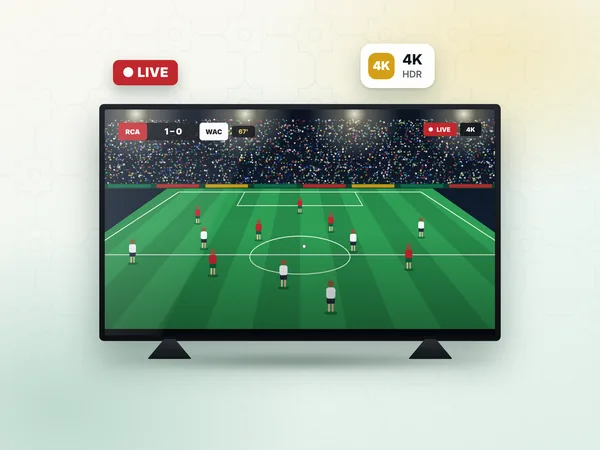
Live TV
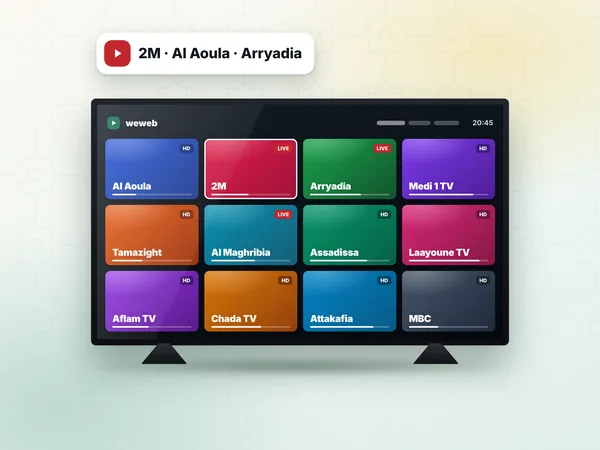
Channels playing now, exactly as on a satellite receiver: news, matches, series at their broadcast time.
IPTV guide
What is IPTV? It is television delivered over the internet instead of through a satellite dish, an aerial or a cable network. This guide explains it in plain words, for viewers in Morocco and for Moroccans abroad, before you choose an IPTV subscription or read about the weweb service on the IPTV Morocco page.
You will learn how the signal reaches your screen, the difference between live channels, on-demand films and catch-up, what the EPG is, the two kinds of login you can receive, what equipment you need, how IPTV compares with satellite, and whether it is worth it for your household.
IPTV stands for Internet Protocol Television: TV channels sent as data over the internet, the same way a video call or a YouTube clip reaches you. Instead of a dish catching a signal from a satellite, an app on your TV or phone receives the channel from a server and plays it.
For the viewer, the result looks like ordinary television. You open an app, choose a category such as Moroccan channels, sport or kids, pick a channel and watch. The difference is behind the screen: no installer on the roof terrace, no cables between rooms, and the same channels on any device with an internet connection, at home or travelling.
Streaming services such as Netflix also use the internet, but they offer only on-demand titles. IPTV adds live channels, which is what matters for the evening news on 2M, a Botola match on Arryadia or a royal speech on Al Aoula.
IPTV works in four stages: the provider receives the channels, encodes them into internet streams, sends them through servers, and your player app decodes them on your screen. You only see the last step.
The provider receives the channels from their sources and converts each one into a digital stream.
The streams are sent to servers built to deliver video to many viewers at once.
Your internet connection carries the stream you select, and only that one, to your home.
The player app on your device decodes the stream and shows the picture, the sound and the guide.
Because only the channel you watch travels to your home, the picture depends on two things: the quality of the source and the stability of your connection. That is why every serious provider tells you to check your internet speed for IPTV before buying.
An IPTV service usually combines three kinds of content, and the app shows them in separate menus.
Channels playing now, exactly as on a satellite receiver: news, matches, series at their broadcast time.
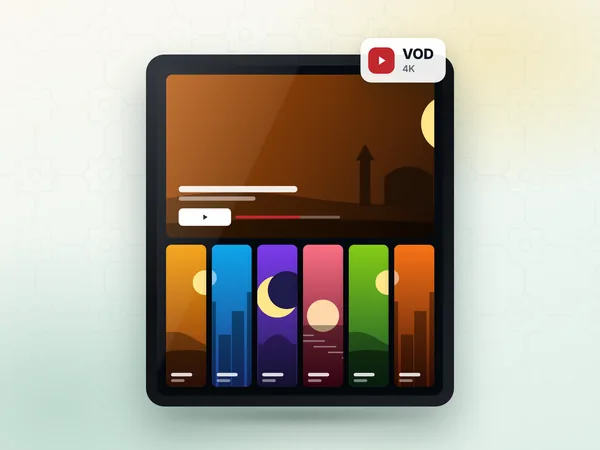
A library of films and series you start whenever you like, with pause and rewind.
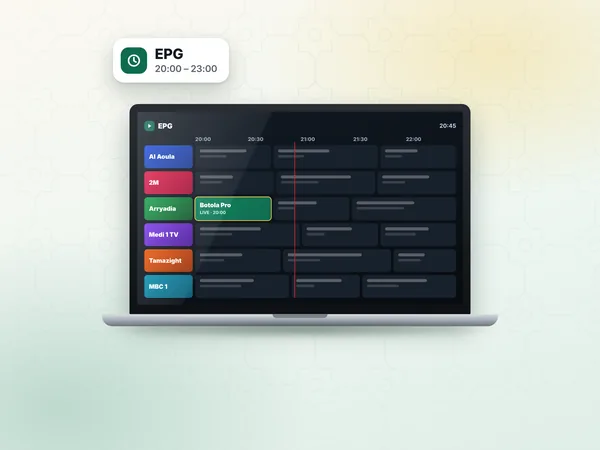
On the channels that support it, programmes that aired in the last few days, ready to replay.
Catch-up is not available on every channel; the app marks the ones that offer it. For Moroccans abroad dealing with a time difference, it is one of the most useful features.
EPG means Electronic Programme Guide: the grid that shows what is on each channel now and next, with the start time and a short description. In an IPTV app it appears when you scroll through the channels or open the guide view.
A good EPG turns a long channel list into something you can actually use. You can see that the evening series starts on 2M at a given time, spot tonight's match before you sit down, and on channels with catch-up, jump straight back to a programme that has already started. Most apps show the guide in your device's local time, which helps a lot when you watch from abroad.
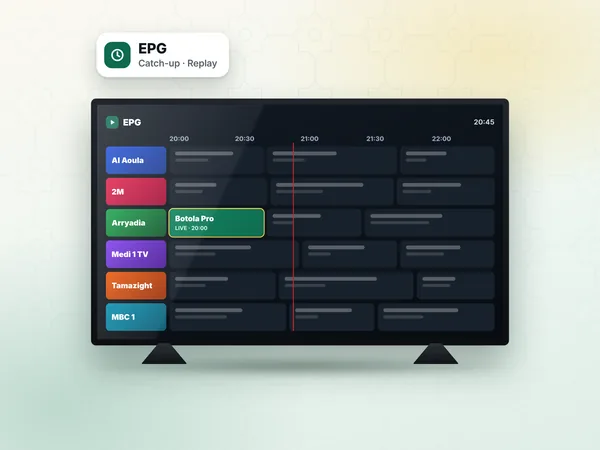
The current programme and the next one, shown under each channel name.
Several hours ahead for every channel, like a printed TV magazine.
If the guide shows the wrong times or stays empty, it is usually a setting in the app. The fix is on the IPTV troubleshooting page.
When you buy IPTV, you do not receive a box or a card; you receive a login for a player app, in one of two formats. Both open the same channels.
The first format is a set of Xtream Codes details: a server address, a username and a password. They load the live channels, the films and the TV guide in one go, and most modern apps prefer them. The second is an IPTV M3U link: one web address that contains the channel list, useful for apps and devices that only accept a playlist.
The IPTV setup guide tells you which app suits your device and walks you through it. For the connection, see internet speed for IPTV, which covers Maroc Telecom, inwi, Orange and 4G.
Satellite and IPTV both bring live channels; they simply use different roads. A dish is a one-off purchase that keeps working without internet and shows the free-to-air channels at no extra cost. IPTV needs a connection and a subscription, but adds international packs, sport, films on demand and catch-up, on every screen of the house without extra cables.
The full side-by-side comparison, with cost, installation, picture, weather and multi-room use, is on our IPTV vs satellite page.
IPTV is worth it if you have a stable internet connection and want more than the free-to-air channels: international channels, full sports packs, films on demand, or Moroccan TV while living abroad. It is less useful if your connection is weak in the evening or if you only ever watch two or three national channels.
To put a number on it: Standard 300 DH, Premium 450 DH and VIP 600 DH, each for 12 months, paid once. Standard works out at ≈ 25 DH a month, and VIP, with the biggest catalogue and 1 or 2 devices used one at a time, at ≈ 50 DH.
Never judge on promises. A free test on your own line, at the hour you usually watch, tells you more than any review.
Ask for a free 24-hour test line on WhatsApp and install an app on your device.
Watch your usual channels in the evening, when the network is busiest.
Choose a plan by catalogue, picture quality and number of devices, and send the prepared WhatsApp message.
Pay, and receive your login within 1 hour, 24 h at most after the payment is confirmed.
The test is explained on the IPTV free trial page, and the three plans are compared on the IPTV subscription page.
Recommended speeds per picture quality, fibre, ADSL and 4G in Morocco, and match-night tips.
Internet speed for IPTVCost per year, channels, installation and weather, compared honestly.
IPTV vs satelliteAnswers
IPTV is television delivered over the internet instead of a dish or cable. A provider such as weweb turns each channel into a stream, sends it through servers, and a player app on your TV, box or phone plays it, using Xtream Codes or an M3U link.
EPG means Electronic Programme Guide: the grid showing what is on each channel now and next, included with the weweb channels. In most apps it follows your device's local time, which helps when you watch from abroad.
It is worth it if you have a stable connection and want more than the free-to-air channels: sport, international packs, films or Moroccan TV abroad. weweb plans cost 300 / 450 / 600 DH for 12 months, and a free 24-hour test lets you decide on your own line.
Pick the plan that matches your devices and picture quality, or test it first on your own connection.